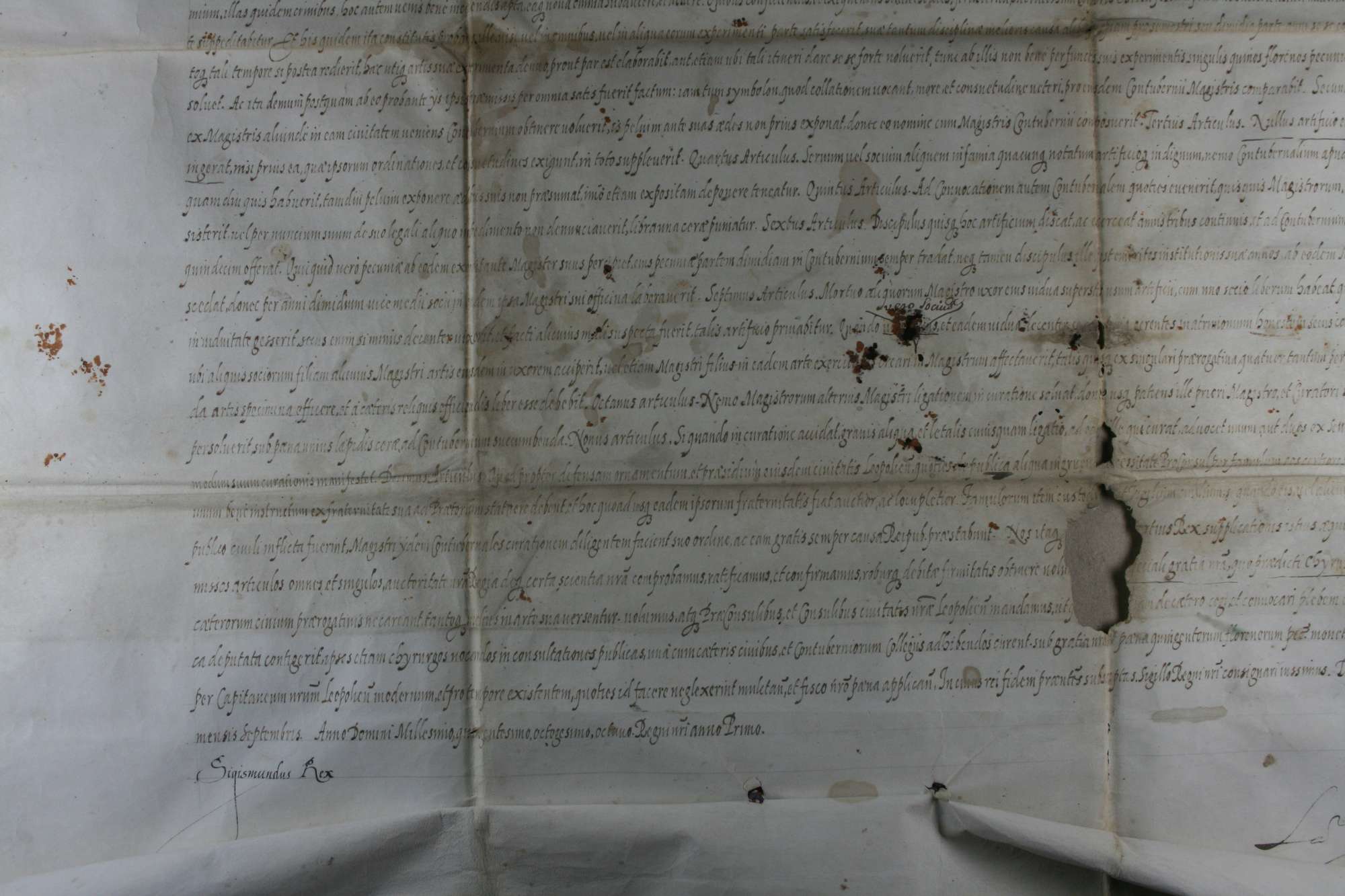
Translation / modern text
SIGISMUND
[S]igismund the Third, by the grace of God, King of Poland, Grand Duke of Lithuania, Ruthenia, Prussia, Masovia, Samogitia, Livonia, and also by the same grace appointed King of Sweden, heir to the Grand Duchy of Finland. We hereby announce by this our letter to all and each in particular whom it may concern: That whereas a petition was submitted to us in the name of the surgeons of Lwów, that we might deign to approve and strengthen certain articles for the proper order of their brotherhood, legally established by the municipal magistrate of Lwów, and subsequently also confirmed by the King of blessed memory, Stephen, which [articles] read as follows:
First. A companion who would like to be created a master, arriving here from elsewhere, once he has worked for a just time under one of the guild masters, should present letters certifying his honest origin and where he learned this craft, accept municipal law before the magistrate of this city, and deposit one mark of money into the common guild treasury for his first entry. Next, he shall specifically lay out for the same guild ten florins, counting thirty groschen each, for the provision of common armament; only then shall he perform and show the trials or demonstrations of his craft in the presence of the masters of the whole guild, according to the types of things as described here, of which the first is called Gratia Dei, the second Emplastrum Galmeiense, the third Unguentum fuscum, the fourth Pulvis ossium, the fifth Emplastrum [...]sanum, the sixth, seventh, and eighth: needle, scissors, forceps[...], [...] suitable for proper wrapping, those with wax, and these [...], and he must smoothly execute and sharpen all of this. For the execution and completion of this, a fixed day is appointed: the Tuesday falling immediately after the feast of the Most Holy Body of Christ, and all material shall be provided by the brotherhood. And after such establishment [...], whether he has satisfied in everything or in some part of these trials, [if he were to leave] only for the sake of his better training [...], and if he were to return at such a time later, then he shall certainly perform these trials of his craft anew, as is proper; or if he wished to go on such a journey, then he shall pay five florins of money to the guild for those poorly completed trials of his. And only then, when after his submitted proofs satisfaction is given in everything, shall he prepare a treat for the masters of the same guild, which they call a supper, according to old custom and usage.
Second article. If any master arriving from elsewhere to this city would like to obtain membership in the guild, let him not hang a basin before his house until he has reached an understanding with the masters of the guild in this matter.
Third article. Let no one dare to practice their craft if he has not previously fully fulfilled what their ordinances and customs require.
Fourth article. Let no guild companion keep a servant or apprentice stained with any infamy and unworthy of this craft. For as long as someone keeps such a person, let him not dare to display a basin before his house, and he is even obliged to remove one already displayed.
Fifth article. For a guild meeting, whenever it occurs, whoever among the masters or companions does not appear, or does not report some legal obstacle through his messenger, shall pay a pound of wax.
Sixth article. Let every apprentice learn this craft and practice it for three continuous years, and upon presentation, let him offer fifteen groschen to the guild. Whatever sum of money would be taken from him, let his master pay it and always give half of this money to the guild; and yet that apprentice, after the years of his training have passed, cannot leave that master until he has worked for half a year in the capacity of a half-companion in that same workshop of his master.
Seventh article. When one of the masters dies, the widow left behind is to have free practice of the craft with one apprentice as long as she behaves decently in her widowhood; otherwise, if she lived less decently [or] was caught with someone [...], such a one shall be deprived of the craft. When, however, one of these decently behaving widows enters into an honest marriage with one of them, as well as when one of the companions takes as his wife the daughter of one of the masters of this craft, or the son of a master trained in the same craft [...] desires to be created a master, each such person, by reason of a special privilege, shall be required to perform only four trials of the craft, designated by the guild, and shall be free from other remaining duties.
Eighth article. Let no master undo the dressing of another master during treatment until that patient has paid in full the payment to the first master and his physician, under penalty of one stone of wax for the benefit of the guild.
Ninth article. If ever during treatment a difficult and fatal case happens to anyone, the one who is treating shall call one or two senior masters to him and reveal his method of cure to them.
Tenth article. That for the sake of the defense, ornament, and safety of the same city of Lwów, whenever there is some urgent public need, the mayor [or councilors] [...], they should station one well-equipped armed man from their brotherhood under the town hall, and this for as long as their brotherhood does not become more numerous and wealthier. Also, if wounds were inflicted upon the city guards [...] in [...] for the public good of the city, the same guild masters shall, by virtue of their office and in turn, conduct careful treatment and shall always provide it for free for the Republic.
We, therefore, [Most Serene King, having considered the justice of these requests], approve, ratify, and confirm all and individual articles by our royal authority and from our certain knowledge, and we wish that they gain the force of due permanence [...] by our special grace, so that the said surgeons of Lwów are not deprived of the prerogatives granted to other citizens and all the more [...] strive in their art: we also wish and order the mayors and councilors of our city of Lwów that [...] in the future, when it happens that the commonalty of the city of Lwów is gathered and summoned to designated places, they should also take care to summon those surgeons to public councils, admitting them together with the other citizens and craft guilds, under penalty of the loss of our favor and a fine of five hundred florins in Polish currency and number, to be collected by our Lwów starosta present and serving at the given time, whenever they would neglect to do so, and the fine is to fall to our treasury. In witness whereof, we have signed this letter with our own hand [and] ordered it to be affixed with the seal of our Kingdom. Given in Kraków, on the third day of the month of September, in the Year of our Lord one thousand five hundred and eighty-eight, the first year of our reign.
Sigismund, King
[Chancery note / signature:]
L. Gembicki, deputy
[Seal:]
[Smaller royal seal of Sigismund III Vasa impressed in red wax in a natural wax bowl, suspended on a multicolored silk cord; in the rim the royal title, in the field a coat of arms with the Eagle, the Vytis, the Vasa Sheaf, etc.]
[Spine / Verso:]
[Archival notes from the 18th–19th centuries: among others] Privilege of Sigismund the Third [...] No. 728 [and other signatures and register notes].
Original wording — transcription
SIGISMVNDVS
[S]igismundus Tertius Dei gratia Rex Poloniae, Magnus Dux Lithuaniae, Russiae, Prussiae, Masouiae, Samogitiae, Liuoniaeq[ue], nec non eadem gratia designatus Rex Sueciae, Magnus Ducatus Finlandiae Haeres. Significamus praesentibus literis n[ost]ris quorum interest uniuersis et singulis. Quod cum supplicatum nobis esset Chyrurgorum Leopolien[sium] nomine, ut certos articulos ad rectum ordinem fraternitatis ipsorum, a Magistratu ciuili Leopoli[ensi] legitime constitutos, deinde etiam a D[iuo] Stephano Rege confirmatos, nos quoq[ue] comprobare, confirmareq[ue] dignaremur, qui quidem ij sunt. Primus. Socius qui in Magistrum creari uoluerit, aliunde huc ueniens, dum prius apud aliquem ex Magistris Contubernalibus iusto tempore laborauerit, literas comprobat[i]onis ortus sui legittimi, ac ubi artificium hoc didicit, opus est ut exhibeat, Ius Ciuile apud Magistratum eius ciuitatis suscipiat, et ad commune Contuberniu[m] depositorium pro primo ingressu marcam unam pecuniae reponat. Deinde specialiter etiam eidem Contubernio pro comparanda communi armatura florenos decem grossis triginta singulos computari impendat, tum demum experimenta seu specimina eius artificij in praesentia Magistrorum totius eiusdem Contubernij conficiat atq[ue] commonstret, per eas ut hic descriptae sunt rerum species, quarum Prima uocatur Gratia Dei, Secunda Emplastrum Galmeien[se], Tertia Unguentum fuscum, Quarta Puluis ossium, Quinta Emplastrum [...]sanum, Sexta uero, septima, et octaua Aguaculam, forsiculus, Polegolo[...], [m]inum, illas quidem cerinibus, hoc autem uemis bene inuoluendis apta, eaq[ue] uana omnia subduceret et acuere. Quibus conficiendis et exequendis stata est dies, feria tertia Sacratissimi Corporis Christi festum proxime succedens, ubi materia omnis ex fraternitate suppeditabitur. Et his quidem ita constitutis [...], uel in omnibus, uel in aliqua eorum experimenti parte satisfecerit, sua tantum disciplinae melioris causa [...], tog[ue] tali tempore si postea redierit, hac utiq[ue] artis sua[e] experimenta deuuo, prout par est, elaborabit, aut etiam ubi tali itineri dare se se forte uoluerit, tunc ab illis non bene perfunctis suis experimentis singulos quinos florenos pecuniae ad Contuberniumq[ue] soluet. Ac ita demum postquam ab eo probantiijs ipsius praemissis per omnia satis fuerit factum: iam tum symbolon, quod collationem uocant, more et consuetudine ueteri, pro eadem Contubernij Magistris comparabit. Secundus Articulus. Si quis ex Magistris aliunde in eam ciuitatem ueniens Contubernium obtinere uoluerit, is peluim ante suas aedes non prius exponat, donec eo nomine cum Magistris Contubernij composuerit. Tertius Articulus. Nullus artificio eorum operando se se ingerat, nisi prius ea, quae ipsorum ordinationes et consuetudines exigunt, in toto suppleuerit. Quartus Articulus. Seruum uel socium aliquem infamia quacunq[ue] notatum artificioq[ue] indignum nemo Contubernalium apud se foueat. Talem enim quamdiu quis habuerit, tamdiu peluim exponere aedibus suis non praesumat, imo etiam expositam deponere teneatur. Quintus Articulus. Ad Conuocationem autem Contubernalem quoties euenerit, quisquis Magistrorum, uel sociorum se se non sisterit, uel per nuncium suum de suo legali aliquo impedimento non denunciauerit, libram una[m] cerae fumiatur. Sextus Articulus. Discipulus quisq[ue] hoc artificium discat, ac exerceat annis tribus continuis, et ad Contubernium praesentationis grossos quindecim offerat. Quicquid uero pecuniae ab eodem exactum sit, Magister suus persoluat, eius pecuniae partem dimidiam in Contubernium semper tradat, neq[ue] tamen discipulus ille post exactos institutionis suae annos, ab eodem Magistro mousquam discedat, donec per anni dimidium uice medij socij in eadem ipsa Magistri sui officina laborauerit. Septimus Articulus. Mortuo aliquorum Magistro uxor eius uidua superstes usum artificij, cum uno socio liberum habeat, quoad usq[ue] decenter se se in uiduitate gesserit, secus enim si minus decenter uixerit, [uel] se alicuius medijs uisperta fuerit, talis artificio priuabitur. Quando uero ex eisdem uidua decenter se se gerentis matrimonium honeste ijsdem contraxerint, ac similiter ubi aliquis sociorum filiam alicuius Magistri artis eiusdem in uxorem acceperit, uel etiam Magistri filius in eadem arte exercit[us] [...] creari in Magistrum affectauerit, talis quisq[ue] ex singulari praerogatiua quatuor tantum per Contubernium assignan[da] artis specimina efficere, et a caeteris reliquis officialibus liber esse debebit. Octauus articulus. Nemo Magistrorum alterius Magistri ligationem in curatione soluat, donecusq[ue] patiens ille priori Magistro, et curatori suo mercedem integram persoluerit, sub poena unius lapidis cerae, ad Contubernium succumbenda. Nonus articulus. Si quando in curatione accidat, grauis aliqua et letalis cuiusquam ligatio, ad eam ille qui curat, aduocet unum aut duos ex Senioribus Magistris, eisq[ue] modum suum curationis manifestet. Decimus Articulus. Quod propter defensam, ornamentum, et praesidium eiusdem ciuitatis Leopolien[sis] quotiescunque publica aliqua ingruente necessitate Proconsul [aut Consules] [...] Armatum unum bene instructum ex fraternitate sua ad Praetorium statuere debent, et hoc quoad usq[ue] eadem ipsorum fraternitatis fiat auctior, ac locupletior. Famulorum item custodiae [...] vulnera in [...] pro publico ciuili inflicta fuerint, Magistri ijdem Contubernales curationem diligentem facient suo ordine, ac eam gratis semper causa Reipub[licae] praestabunt. Nos itaq[ue] [Serenissimus Rex supplicationibus istius aequitatem perpendentibus praemissos] articulos omnes et singulos, auctoritate n[ost]ra Regia et ex certa scientia n[ost]ra comprobamus, ratificamus, et confirmamus, roburq[ue] debitae firmitatis obtinere uolu[mus] [...] speciali gratia n[ost]ra, qua praedicti Chyrurgi Leopolien[ses] donatorum caeterorum ciuium praerogatiuis ne careant, tantoq[ue] [...] in arte sua uersentur: uolumus atq[ue] Praeconsulibus, et Consulibus ciuitatis n[ost]rae Leopolien[sis] mandamus, ut [...] de caetero cogi et conuocari plebem ciuitatis Leopolien[sis] ad loca deputata contigerit, ipsos etiam Chyrurgos uocandos in consultationes publicas, una cum caeteris ciuibus, et Contuberniorum collegijs adhibendos curent, sub gratia n[ost]ra et poena quingentorum florenorum pec[uniae] monetae et numeri polonicalis per Capitaneum n[ost]rum Leopolien[sem] modernum, et pro tempore existentem, quoties id facere neglexerint mulctan[da], et fisco n[ost]ro poena applican[da]. In cuius rei fidem praesentis subscrips[i] [et] Sigillo Regni n[ost]ri consignari iussimus. Dat[um] Cracouiae die tertia mensis Septembris, Anno Domini Millesimo, quingentesimo, octogesimo, octauo, Regni n[ost]ri anno Primo.
Sigismundus Rex
[Nota kancelaryjna / podpis:]
L. Gembicki s[ubstitutus]
[Pieczęć:]
[Pieczęć mniejsza koronna Zygmunta III Wazy wyciśnięta w czerwonym wosku w misce z wosku naturalnego, zawieszona na jedwabnym, wielobarwnym sznurze; w otoku tytulatura królewska, w polu tarcza herbowa z Orłem, Pogonią, Snopkiem Wazów etc.]
[Verso:]
[Zapiski archiwalne z XVIII–XIX w.: m.in.] Privilegium Sigismundi Tertii [...] N[ume]ro 728 [oraz inne sygnatury i noty regestowe].