
Mercy under pressure. Khmelnytsky and Lviv in October 1655
In letters from the camp outside Lviv, threats sit alongside assurances of friendship, and high politics alongside instructions to arrive the next morning. The hetman wants one thing from the city: a decision. To obtain it, he controls the timing, terms of discussion and guarantees of safety.
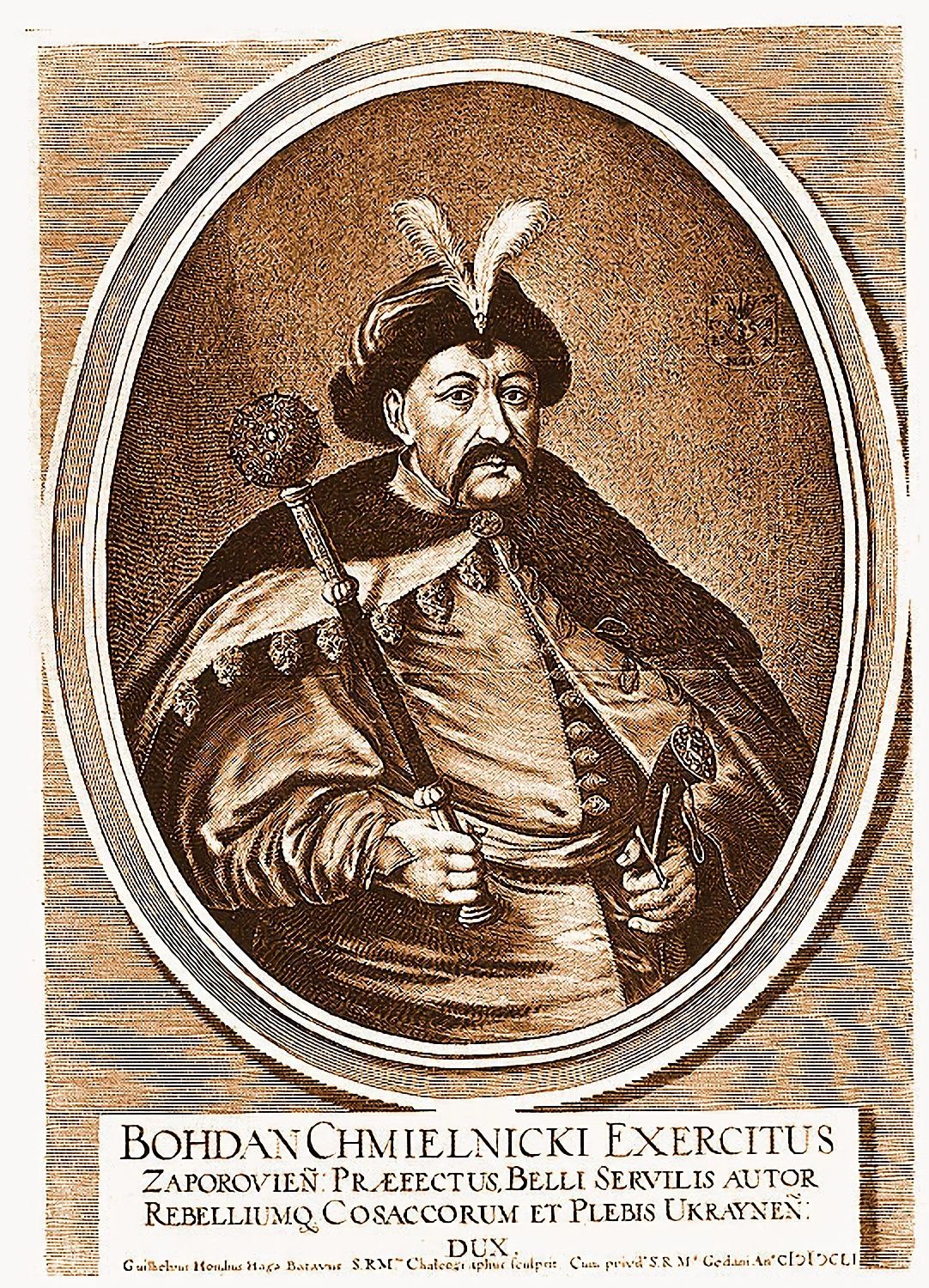
Autumn 1655: a city between two armies
In autumn 1655 the Polish–Lithuanian Commonwealth was fighting on two fronts. Since July the Swedes had been occupying Greater Poland and Warsaw, while a Cossack–Muscovite army advanced from the east: Bohdan Khmelnytsky together with the voivode Vasily Buturlin. In late September the forces of Hetman Stanisław Potocki were defeated near Horodok, opening the road to Lviv. The city, already besieged by Khmelnytsky in 1648, once again had to negotiate with an army camped outside its walls.
The series of the hetman’s letters to the magistracy preserved in fond 132, dated 3–22 October 1655, records those negotiations from the sender’s perspective. Lviv submitted neither to the Cossacks nor to the tsar; it bought its release with a ransom and saw the troops depart in November. The course of the siege is known from Zubrzycki’s chronicle and Hrushevsky’s synthesis; the letters show how pressure on the city was built step by step.
Sources and bibliography
- Denys Zubrzycki, Kronika miasta Lwowa, Lwów 1844 (przekład ukraiński: Хроніка міста Львова, Lwów 2002) ↗
- Mychajło Hruszewski, Історія України-Руси, t. IX, cz. 2, Kijów 1931 (oblężenie Lwowa 1655)
- Iwan Krypjakewycz, Богдан Хмельницький, wyd. 2, Lwów 1990
Not a single manifesto, but a sequence of exchanges
The letters are best read as a series of moves rather than isolated declarations. The city receives a demand for an answer, sends representatives, waits for terms and is summoned to negotiate again. Each document performs a small part of the negotiating work. Together they reveal the tension between the sender’s military superiority and his need to obtain a specific decision from the recipient.
The argument of this study follows from that tension: the proclaimed mercy was both a promise of safety and an instrument of pressure, because receiving it depended on the city’s conduct. We have only one side of the correspondence. The magistracy’s replies, the envoys’ oral discussions and the enclosures mentioned in the letters are not preserved in this unit. Zubrzycki’s account, based on municipal records, partly fills that gap.
Victory at Horodok as an argument
In the letter of 3 October (132/1/2), the hetman presents his actions as a response to the Crown army’s conduct, recalls the mercy previously shown to the city and invokes his victory at Horodok. He uses these three elements to demand an immediate answer. More than displaying strength, he specifies in advance who will bear responsibility for further bloodshed.
The letter of 4 October (132/1/3) adds that waiting for relief is pointless. The promise to remain outside the city is coupled with a threat should it refuse. Words of friendship do not cancel that threat: they describe the more favourable outcome available if the demand is met. The old Polish word “politowanie” here means mercy, immediately assigning the roles: the city petitions, the hetman grants clemency.
Próżna wasza o posiłku nadzieja
Sources and bibliography
Hostages: the limits of trusting a promise
The most concrete dispute concerns the delegation’s safety. In his letter of 5 October (132/1/4), Khmelnytsky responds to a demand for hostages, called by the Latin word obsides. The city seeks security for the people it sends; the hetman invokes his word, the mercy previously shown and the authority of his office, describing the demand for an additional guarantee as obstinacy.
This reveals the practical cost of negotiations: someone must leave the walls and enter the other side’s camp. A promise to preserve life and health is therefore no mere chancery ornament, but a condition without which talks cannot proceed. Further letters, dated 9 and 10 October (132/1/7, 132/1/8 and 132/1/9), return to the dismissal of envoys and the question of interrupted negotiations; 132/1/9 mentions three people being sent away. Among Lviv’s envoys to the camp was Samuel Kuszewicz, a councillor and later chronicler of the sieges, whose accounts Zubrzycki used.
Upewniamy, gdy waszą obaczymy pokorę, przy całości zdrowia zachowani będziecie.
Sources and bibliography
Tomorrow morning: negotiations have a timetable
The delegation’s arrival time repeatedly appears in the letters. Requiring an answer the following morning shortens the time for deliberation and increases pressure, while also organising the exchange of envoys. In 132/1/6 the hetman announces a night-time council with his military senior officers and expects the city’s representatives as early as possible in the morning. Letter 132/1/5 instructs the city to hear the hetman’s delegates, who have received his position orally. Written and spoken channels complemented each other, so the reader of a letter never receives the entire conversation.
Dating complicates the chronology. The original and the date clause of the published text give 6 October, whereas the heading of item 332 in the 1961 edition gives 8 October. Both indications are retained here; resolving the discrepancy requires renewed collation with the original.
a my tymczasem tejże nocy ze wszystką starszyzną wojsk naszych pomyślimy
Sources and bibliography
From declarations to ransom
The second half of the series shows the subject of discussion changing. On 13 October (132/1/10), the hetman reports that terms have been delivered in writing and awaits an answer. On 14 October (132/1/11), he allows further petitions to be considered. On 19 October (132/1/12), he passes on news of Kraków, which had just capitulated to the Swedes, and announces that Grodzicki will be sent. Finally, on 22 October (132/1/13), he sends men to collect the “agreed honorarium”, meaning the negotiated ransom, and demands their swift dispatch.
The movement from assurances of mercy to collection of a payment is why the series should be read as a whole. The letter of 22 October alone gives neither the amount nor proof of its full receipt. According to Zubrzycki and Hrushevsky, the city undertook to pay a large ransom but paid only part, in cash and goods. A full accounting would require municipal accounts and receipts.
dzisia posyłamy kilka osób naszych dla odebrania tego honorarium postanowionego
Two letters outside the siege
The units adjoining the series do not belong to the negotiations of 1655. The first, 132/1/1, is Bohdan Khmelnytsky’s letter to János Kemény of 29 March 1653, written in Latin at Subotiv. It maintains friendship with the Transylvanian commander and future prince at a time when the hetman was seeking allies against the Commonwealth and in Moldavian affairs. It must not be confused with a different letter to George II Rákóczi bearing the same date.
The second, 132/1/14, is a letter from Yurii Khmelnytsky, Bohdan’s son and hetman in 1659–1663, sent from Chyhyryn on 24 January 1661 to Lviv’s mayor: a recommendation for Pavlo Teteria. Both units show that the Khmelnytskys’ contacts with Lviv extended beyond sieges, but they are not part of the negotiations discussed here.
What has been published, and what still needs checking
Letters 132/1/2–6 have counterparts in the 1961 volume Документи Богдана Хмельницького: numbers 328, 329, 330, 332 and 331 respectively. Identification rests on incipits, details of content and date clauses, not merely on similar subject matter. The concordance for the remaining letters in the series is not yet complete. An earlier point of reference is Zubrzycki’s chronicle, which summarises the negotiations from municipal records; the apparatus of the 1961 edition refers to its pages.
Taras Barabash’s 2014 article examines the style and handwriting of the hetman’s letters to Lviv’s magistracy and also reproduces passages from the letter to Kemény. Quotations in this study come from the project’s working transcriptions, with spelling partly modernised. They are not diplomatic transcriptions and should be checked against the scans for scholarly use.
Sources and bibliography
Bibliography
Principal editions and studies useful for reading the series.
Sources and bibliography
- Документи Богдана Хмельницького 1648–1657, oprac. Iwan Krypjakewycz, Iwan Butycz, Kijów 1961 ↗
- Denys Zubrzycki, Kronika miasta Lwowa, Lwów 1844 (przekład ukraiński: Хроніка міста Львова, Lwów 2002) ↗
- Mychajło Hruszewski, Історія України-Руси, t. IX, cz. 2, Kijów 1931
- Iwan Krypjakewycz, Богдан Хмельницький, wyd. 2, Lwów 1990
- Władysław Łoziński, Patrycjat i mieszczaństwo lwowskie w XVI i XVII wieku, wyd. 2, Lwów 1902
- Історія Львова, red. Jarosław Isajewycz, Myron Kapral, Feodosij Steblij, t. 1–3, Lwów 2006–2007
- Taras Barabasz, artykuł o listach Chmielnickiego do magistratu Lwowa, Kijów 2014 ↗